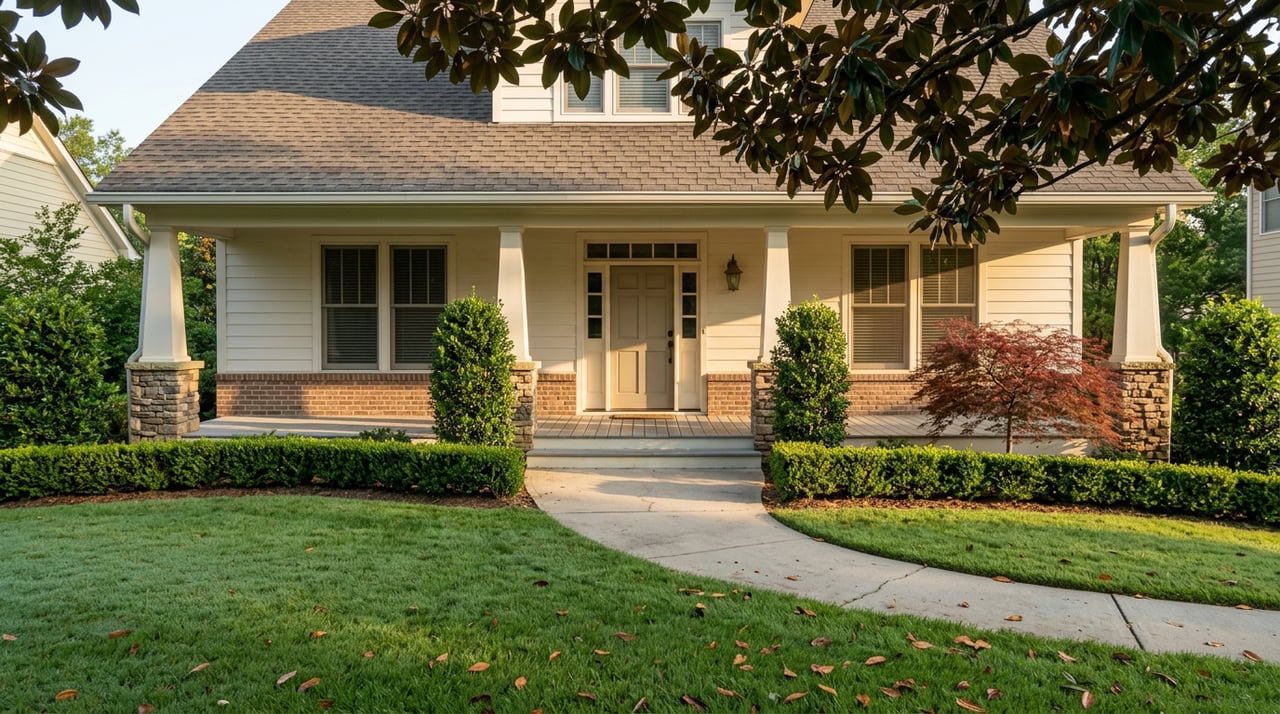
Woodstock Knoll's Golf Cart Perk Has a Permit Attached. Here's What It Actually Takes.
September 24, 2026
September 24, 2026
Every listing for Woodstock Knoll mentions the golf cart. Hop in, ride down to Main Street, grab dinner, come home. It's one of the neighborhood's most repeated selling points, and for good reason: Woodstock Knoll sits close enough to downtown that a cart ride genuinely beats circling for parking on a Friday night.
What most of that copy leaves out is that the cart itself has to qualify, and so do you. Georgia does not make golf carts street legal by default. The city of Woodstock does, but only through a specific ordinance with its own paperwork, its own equipment list, and its own age rules. If you already live in Woodstock Knoll and you're thinking about buying a cart, or you bought one years ago and never registered it, this is the part nobody put in the brochure.
Woodstock Knoll is a 321-home neighborhood built between roughly 2009 and 2017, tucked close enough to downtown that residents routinely make the trip without a car. The community runs its own clubhouse with a fitness room, a junior Olympic pool with a waterslide, three tennis courts (two of which convert for pickleball), a playground, and a fishing pond. Homes here feed into Woodstock Elementary, Woodstock Middle, and Woodstock High.
None of that is unusual for a Cherokee County subdivision built in that window. What sets Woodstock Knoll apart, and what its own marketing leans on hardest, is the walk-or-cart distance to Main Street. That's a real advantage. It's also the part that comes with rules most buyers never ask about until they're standing in the driveway with a cart they can't legally drive past their own mailbox.
Under Georgia law, a plain golf cart, the kind built to move players and clubs around a course, tops out under 15 miles per hour and has no business on a public street at all. What most people actually drive around a neighborhood like Woodstock Knoll is technically a Personal Transportation Vehicle, or PTV: a cart with at least four wheels, a top speed under 20 miles per hour, an unladen weight capped at 1,375 pounds, and seating for no more than eight people.
That distinction matters because Georgia state law does not make PTVs street legal statewide. It hands that decision to individual cities and counties. Without a local ordinance, a cart, however it's classified, has no legal path onto a public road, full stop. Woodstock passed that ordinance. Not every city in Cherokee County has.
The city's rule is straightforward once you know it exists, but it is not automatic. Personal Transport Vehicles are permitted on city streets with a "posted speed limit of 25 miles per hour or less," and that's the ceiling. There's no version of the ordinance that puts a cart on Highway 92 or Arnold Mill Road at rush hour.
To drive one legally from Woodstock Knoll into downtown, the city requires:
The city also publishes an interactive PTV Access Map so residents can check which specific streets are covered before they pull out of the driveway. That matters more in a neighborhood like Woodstock Knoll than it does somewhere further out, because the whole appeal of the cart is the door-to-Main-Street trip, and that trip only works if every street along the way is actually on the map.
Woodstock Knoll's amenity list practically invites teenagers to want their own set of wheels for the pool-to-downtown loop, and the city's age rules are more layered than most residents expect.
| Age | What's allowed |
|---|---|
| 12 to 14 | May operate a PTV only with a licensed adult, 18 or older, riding in the front seat |
| 15 | May operate a PTV alone with a valid learner's permit |
| 16 and up | May operate under the same driver's license standards as any other road use |
That middle tier catches people off guard. A 15-year-old with a permit can legally drive a registered PTV solo under Georgia's framework, but a 13-year-old cannot, no matter how well they handle the cart around the cul-de-sac. If there's more than one teenager in the house, it's worth checking which tier each one actually falls into before assuming the rules apply evenly.
Registration paperwork is the part people expect. The part that actually stalls most households is the cart itself. A lot of what gets sold and driven around subdivisions like Woodstock Knoll is closer to the strict legal definition of a golf cart, built for a course, capped under 15 miles per hour, never engineered to meet PTV specs. That cart can circle the neighborhood pool loop all day. It cannot legally cross onto a public street toward downtown, decal or no decal, because it was never built to the standard the ordinance is written around.
If the goal is the actual Main Street trip Woodstock Knoll is known for, the cart needs to meet the PTV definition on paper before the registration step matters at all: four wheels, under 20 miles per hour, under 1,375 pounds unladen, seating for no more than eight. Some carts ship that way. Others need modification, and modification changes how they're classified again. It's worth confirming what you're actually driving before you make the trip to the City Hall Annex.
None of this is a reason to skip the cart. It's a reason to register it correctly so the trip is worth taking.
Downtown Woodstock's Main Street runs a Saturday morning farmers market through the growing season, with local produce, baked goods, and live music drawing a steady crowd. On the first Friday of each month, Main Street extends shop hours and turns into a walkable evening out, with galleries and storefronts staying open later than usual. Reformation Brewery and Pure Taqueria both sit close enough to the market and the First Friday footprint that they've become regular stops for people making the trip from neighborhoods like Woodstock Knoll rather than driving in from further out.
That's the actual return on the golf cart perk. It's not the cart itself. It's a legally registered, properly classified vehicle that gets a household from a fishing pond and a pickleball court to a Saturday morning market and a Friday evening out, without anyone worrying about whether the ride was legal in the first place.
Woodstock Knoll's proximity to downtown is real, and the golf cart culture around it is real too. What's less advertised is that the city treats that culture as infrastructure, not novelty, complete with a registration desk, a fee, a map, and an age chart. Checking the rule once, before the season gets busy, is a lot easier than finding out about it from a police officer on Main Street.
If you're weighing what a home in Woodstock Knoll, or a comparable pocket of Woodstock, actually offers day to day, that kind of detail is the difference between marketing language and how a neighborhood really works. Mike Donovan lives and works in this market and is glad to walk through what a specific street, HOA, or amenity package actually means for your daily life here, not just what the listing says. Let's Connect.

Mike Donovan leverages the discipline and integrity of a Marine veteran to deliver a premium real estate experience. With meticulous attention to detail and a commitment to client satisfaction, he transforms buying or selling a home into a seamless and rewarding journey. For Mike, excellence is standard, and every client deserves a path marked by clarity, trust, and confidence.

Mike Donovan
3760 Sixes Rd Ste 108 Canton, GA 30114